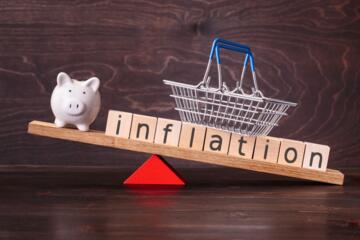
Understanding the Invisible Tax on Your Wealth
Inflation isn’t just a headline figure from the Bureau of Labor Statistics (BLS); it is a fundamental shift in the cost of existence. When the Consumer Price Index (CPI) rises, the nominal value of your currency remains the same, but its "real" value—what it can actually buy—drops. For instance, if inflation sits at 4% annually, a $1,000,000 retirement nest egg effectively loses $40,000 in purchasing power in just twelve months.
In professional finance, we look at the "Real Rate of Return." If your savings account at Marcus by Goldman Sachs offers a 4.40% APY, but inflation is at 3.5%, your actual wealth growth is a mere 0.9%. Most people ignore this delta, leading to a "money illusion" where they feel richer because their bank balance grows, even though their ability to afford a home in Austin or a liter of fuel in London is diminishing. Recent data shows that even as wages grew by roughly 4.5% in 2023-2024, the cost of "non-discretionary" items like insurance and rent outpaced those gains in several metropolitan hubs.
The High Cost of Financial Inertia
The primary mistake most individuals make during inflationary periods is maintaining a "Cash is King" mentality. While liquidity is vital for emergencies, holding excessive cash in a standard Chase or Bank of America checking account—yielding near 0.01%—is a guaranteed way to lose wealth. This is the "Safety Trap": the perceived security of a bank balance masks the mathematical certainty of loss.
Another critical pain point is the "Lifestyle Creep" paired with "Shrinkflation." You might notice that your grocery bill at Whole Foods has stayed consistent, but the weight of the cereal box has dropped from 15oz to 12oz. Consumers often fail to adjust their budget for these subtle shifts, leading to credit card debt. With the average credit card APR now hovering around 21–25%, using debt to cover the inflation gap creates a mathematical death spiral that can take years to reverse.
Strategic Solutions for Capital Preservation
1. Optimize Your Cash via High-Yield Environments
Stop leaving money in "Big Bank" savings accounts. Transition your emergency fund to High-Yield Savings Accounts (HYSA) or Money Market Funds (MMF).
-
Action: Move idle cash to platforms like Wealthfront or Betterment, which currently offer rates north of 4.50–5.00%.
-
The Result: On a $50,000 emergency fund, shifting from 0.01% to 5.00% generates an extra $2,495 per year. This doesn't make you "rich," but it neutralizes the impact of a 4% inflation rate.
2. Leverage TIPS and I-Bonds
Treasury Inflation-Protected Securities (TIPS) and Series I Savings Bonds are specifically designed to hedge against rising prices. The principal of a TIPS bond increases with inflation and decreases with deflation, as measured by the CPI.
-
Action: Purchase I-Bonds via TreasuryDirect.gov. While there are annual purchase limits ($10,000 per person), they provide a guaranteed floor against inflation.
-
The Result: You lock in a fixed rate plus a variable inflation rate, ensuring your core savings never lose their "real" value, regardless of how high prices climb.
3. Equity and Real Estate Allocation
Historically, the S&P 500 has outperformed inflation over long horizons. Companies with "pricing power"—like Apple, Microsoft, or Visa—can pass increased costs onto consumers, maintaining their profit margins and stock value.
-
Action: Use a brokerage like Vanguard or Fidelity to increase exposure to low-cost index funds (e.g., VOO or VTI). Additionally, consider Real Estate Investment Trusts (REITs) like Realty Income (O), which collect rents that typically rise alongside inflation.
-
The Result: Real assets and equities represent ownership in the economy's productive capacity, which naturally adjusts its nominal pricing as currency devalues.
4. Fix Your Debt Costs
Inflation is the enemy of the saver but the friend of the fixed-rate borrower. If you have a 3% mortgage, inflation at 5% means you are paying back the bank with "cheaper" dollars.
-
Action: Refinance any variable-rate debt (HELOCs, certain student loans) into fixed-rate products immediately. Avoid taking on new high-interest debt for depreciating assets.
-
The Result: You freeze your largest monthly expense while your nominal income (hopefully) rises with annual cost-of-living adjustments, effectively reducing your debt-to-income ratio over time.
Case Studies: Inflation Management in Action
Case 1: The "Cash-Heavy" Professional
Profile: Sarah, a tech consultant with $200,000 in a traditional savings account. The Problem: At 4% inflation and 0.05% interest, Sarah was losing $7,900 in purchasing power annually. The Strategy: She moved $50,000 into a Wealthfront HYSA (5.00%), $10,000 into I-Bonds, and $140,000 into a diversified ETF portfolio via Schwab. The Result: Instead of a $7,900 loss, her "weighted" return moved to approximately 7.2% ($14,400 gain), creating a net real gain of 3.2% over inflation.
Case 2: The Real Estate Pivot
Profile: Mark and Elena, looking to hedge their retirement. The Problem: Their bond-heavy portfolio was yielding 3%, trailing the 4.5% inflation in their specific region (high energy and insurance costs). The Strategy: They reallocated 15% of their bond holdings into a physical rental property and 5% into the Fundrise platform for diversification. The Result: Rental income increased by 6% year-over-year, and the property's market value rose by 5%, significantly outstripping the inflation rate and providing a monthly cash flow cushion.
Inflation Defense Checklist
-
Review Subscription Services: Use Rocket Money or Billshark to audit and cancel "zombie" subscriptions that have quietly raised prices.
-
Audit Insurance Premiums: Home and auto insurance are primary drivers of recent inflation. Get new quotes from Geico, Progressive, or State Farm every 12 months.
-
Calculate Your Personal Inflation Rate: Your rate isn't the national average. If you drive 50 miles a day, fuel prices impact you more. Use a custom spreadsheet to track your top 5 spending categories.
-
Maximize Employer Match: Ensure your 401(k) contributions are at least capturing the full employer match—this is a 100% "instant return" that inflation cannot touch.
-
Evaluate Bulk Purchasing: For non-perishables, a Costco or Sam’s Club membership allows you to "lock in" today's prices for goods you will consume over the next 6 months.
Common Pitfalls to Avoid
Many people panic and move their entire portfolio into speculative assets like volatile cryptocurrencies or "hype" stocks. While Bitcoin is often touted as digital gold, its volatility makes it a poor short-term hedge for essential funds. Diversification remains the only "free lunch" in finance.
Another mistake is neglecting "Human Capital." In an inflationary environment, your ability to earn is your greatest asset. Failing to negotiate a salary increase or failing to upskill via platforms like LinkedIn Learning or Coursera means you are accepting a pay cut every year that inflation exists. If your raise is 3% and inflation is 5%, you have effectively been demoted in value.
FAQ: Navigating the New Economic Reality
Does inflation reduce the value of my debt?
Yes, specifically fixed-rate debt. If you owe $300,000 on a home, that $300,000 becomes "smaller" relative to the economy as prices and wages rise. It is the only benefit of inflation for the average consumer.
Should I buy gold to protect my savings?
Gold is a traditional store of value, but it pays no dividends or interest. While it can be a small part of a portfolio (5–10%), it often underperforms the S&P 500 over long durations, even during inflationary periods.
What is the best investment during high inflation?
Historically, energy stocks, commodities, and high-quality "Value" stocks outperform. Real estate also fares well because replacement costs for buildings rise, pushing up the value of existing structures.
How does inflation affect my stock market returns?
In the short term, high inflation often leads the Federal Reserve to raise interest rates, which can depress stock prices. However, over the long term, equities are one of the few assets that can outpace inflation significantly.
Are High-Yield Savings Accounts (HYSA) safe?
As long as the bank is FDIC-insured (up to $250,000 per depositor), your principal is safe. The risk isn't losing the money; the risk is the interest rate not keeping up with the cost of living.
Author’s Insight: The Practitioner's Perspective
I have spent years analyzing market cycles, and the one thing I’ve learned is that inflation punishes the passive. I remember a client in 2021 who was terrified of the market and sat on $400,000 in cash; by 2024, that cash could buy what $330,000 could have bought when he started. My advice is always to "buy your future costs today." Whether that is through investing in companies that produce the goods you buy or locking in a fixed-rate mortgage, the goal is to stop being a victim of the currency's devaluation. True wealth is built by owning the things that inflation makes more expensive, not by hoarding the currency that is losing value.
Conclusion
Inflation is not a temporary hurdle but a constant factor in modern economics. To protect your financial future, you must transition from a "saver" to an "investor." This involves maximizing the yield on your liquid cash through services like Raisin or Betterment, leveraging the inflation-hedging properties of the stock market, and ensuring your debt is fixed and low-cost. By taking these concrete steps, you ensure that your purchasing power—and your standard of living—remains intact regardless of the Federal Reserve’s next move. Focus on real returns, optimize your tax-advantaged accounts, and treat your personal finances with the same rigor a CEO treats a corporate balance sheet.